







Canadian Building Code Requirements for Industrial Mezzanines
Why Building Codes Matter for Mezzanines
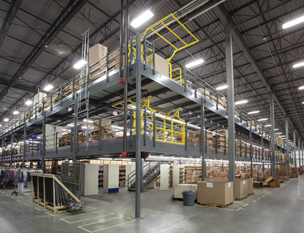
An industrial mezzanine is a structural addition to your building. It adds floor area, changes occupancy calculations, affects fire protection requirements, and introduces new structural loads. This means it falls under Canadian building code jurisdiction in every province.
Understanding the code requirements before you start is not just about compliance. It is about protecting your investment, your employees, and your business. A mezzanine that does not meet code requirements can result in stop-work orders, fines, mandatory removal, or insurance claim denials.
This guide covers the key building code requirements for industrial mezzanines in Canada, including the National Building Code (NBCC) framework and provincial variations.
NBCC Definition: What Qualifies as a Mezzanine?
The National Building Code of Canada (NBCC) defines a mezzanine as an intermediate floor assembly between the floor and ceiling of a room or storey. The critical distinction is that a mezzanine is not counted as a separate storey if it meets certain criteria, which has significant implications for building classification, occupancy limits, and fire protection.
For a floor area to qualify as a mezzanine rather than a full storey under the NBCC:
- It must be an intermediate level within a room or space, not a complete floor across the building
- It must meet the aggregate floor area limit (the 40% rule, discussed below)
- It must be open to the room or space below (though partial enclosures may be permitted)
If a mezzanine exceeds these criteria, it is classified as a full storey, which triggers significantly more stringent code requirements including additional fire separations, egress, and structural considerations.
The 40% Floor Area Rule
The most commonly cited code requirement for mezzanines is the 40% rule. Under the NBCC, the aggregate area of all mezzanines within a room or space must not exceed 40% of the floor area of that room or space.
What this means in practice:
- In a 20,000 square foot warehouse bay, the maximum mezzanine area is 8,000 square feet
- This limit applies to the aggregate of all mezzanine areas in the same room, so multiple smaller mezzanines count toward the total
- If you need more than 40% coverage, the additional floor area is classified as a full storey
Strategies When You Need More Than 40%
If your space requirements exceed the 40% limit, there are legitimate approaches:
- Room separation: Dividing the building into separate rooms (with appropriate fire separations) allows each room to have its own 40% mezzanine allowance
- Full storey classification: Accept the additional storey classification and meet the corresponding code requirements, which is feasible but involves more engineering and cost
- Phased approach: Start with a mezzanine within the 40% limit and plan for expansion as needs evolve
Provincial Variations: ON, QC, BC, AB
While the NBCC provides the national framework, each province adopts and adapts the code through its own building legislation. Here are the key variations for Canada's largest provinces:
Ontario (OBC)
The Ontario Building Code (OBC) closely follows the NBCC for mezzanine requirements. Ontario requires a building permit for all mezzanines and enforces the 40% rule. The OBC has specific requirements for guardrail heights, load testing, and occupancy calculations. Professional engineer involvement is mandatory for structural design.
Quebec (CCQ)
Quebec's Construction Code (Code de construction du Québec) incorporates the NBCC with Quebec-specific amendments. Notable aspects include requirements for bilingual signage on safety features, Quebec-specific fire safety provisions, and the involvement of the Régie du bâtiment du Québec (RBQ) in the permit and inspection process. As a Quebec-based manufacturer, Cogan has deep expertise in Quebec code compliance.
British Columbia (BCBC)
The BC Building Code (BCBC) includes additional requirements for seismic design that are particularly important for mezzanines. Given BC's seismic zone classifications, mezzanine structures in BC often require enhanced lateral bracing and connection details. The BCBC also has specific provisions for industrial occupancies that affect mezzanine design.
Alberta (ABC)
Alberta's building code largely mirrors the NBCC with some variations in energy efficiency requirements and occupancy classifications. Alberta's Safety Codes Council oversees permit administration through accredited municipalities and agencies. Mezzanine permits in Alberta require stamped engineering drawings and inspection at key milestones.
Need Help Navigating Building Codes?
Cogan provides complete engineering packages with PE-stamped drawings for permit submission in every Canadian province.
Get a Free ConsultationLoad Capacity and Structural Codes
The NBCC and CSA standards specify minimum design loads for mezzanines based on their intended use:
| Use/Occupancy | Minimum Live Load (kPa) | Approximate PSF |
|---|---|---|
| Office areas | 2.4 kPa | ~50 PSF |
| Light storage | 4.8 kPa | ~100 PSF |
| Medium storage | 6.0 kPa | ~125 PSF |
| Heavy storage | 12.0 kPa | ~250 PSF |
| Heavy industrial | 24.0+ kPa | ~500+ PSF |
Structural design must account for:
- Uniform live loads (evenly distributed weight)
- Concentrated point loads (heavy equipment or racking legs at specific locations)
- Dynamic loads (forklift traffic, conveyor vibration)
- Lateral forces (seismic and wind loads transmitted through the building)
- Connection design to the existing building floor (anchor bolt capacities in concrete)
Fire Code Requirements
Fire protection is one of the most significant code considerations for mezzanines:
Sprinkler Requirements
If the building has an automatic sprinkler system, the mezzanine area must be protected. The specific requirements depend on the flooring type:
- Bar grating flooring: Open grating allows overhead sprinklers to reach the area below, which may reduce the need for under-mezzanine sprinkler heads
- Solid flooring (diamond plate, resin deck): Typically requires sprinkler heads both above and below the mezzanine
Egress Requirements
- At least two means of egress from any mezzanine with an occupant load exceeding a specified threshold
- Travel distance limits to the nearest exit or stair
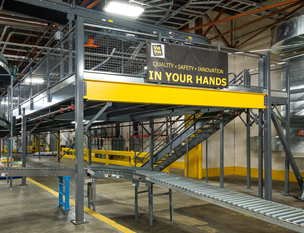
- Stairs must meet code specifications for width, rise, run, and handrail requirements
- Emergency lighting and exit signage on the mezzanine level
Fire Separations
If the mezzanine is used for an occupancy different from the area below (for example, an office above a storage area), a fire separation with an appropriate fire-resistance rating may be required between the two uses.
The Permit Process
The typical permit process for an industrial mezzanine in Canada follows these steps:
- Engineering design: Professional engineer designs the mezzanine and produces stamped drawings
- Permit application: Submit drawings, structural calculations, and application forms to the local building department
- Plan review: The municipality reviews the submission for code compliance (typically 2 to 6 weeks)
- Permit issuance: Once approved, the building permit is issued and construction can begin
- Inspections: Inspections at key milestones (foundation anchors, framing, final) as required by the permit
- Occupancy approval: Final inspection and approval for use
Timeline varies significantly by municipality. Some jurisdictions process mezzanine permits in 2 weeks; others may take 6 to 8 weeks. Cogan's experience with permit submissions across Canada helps anticipate and avoid common delays.
The PE Stamp: Why It Matters
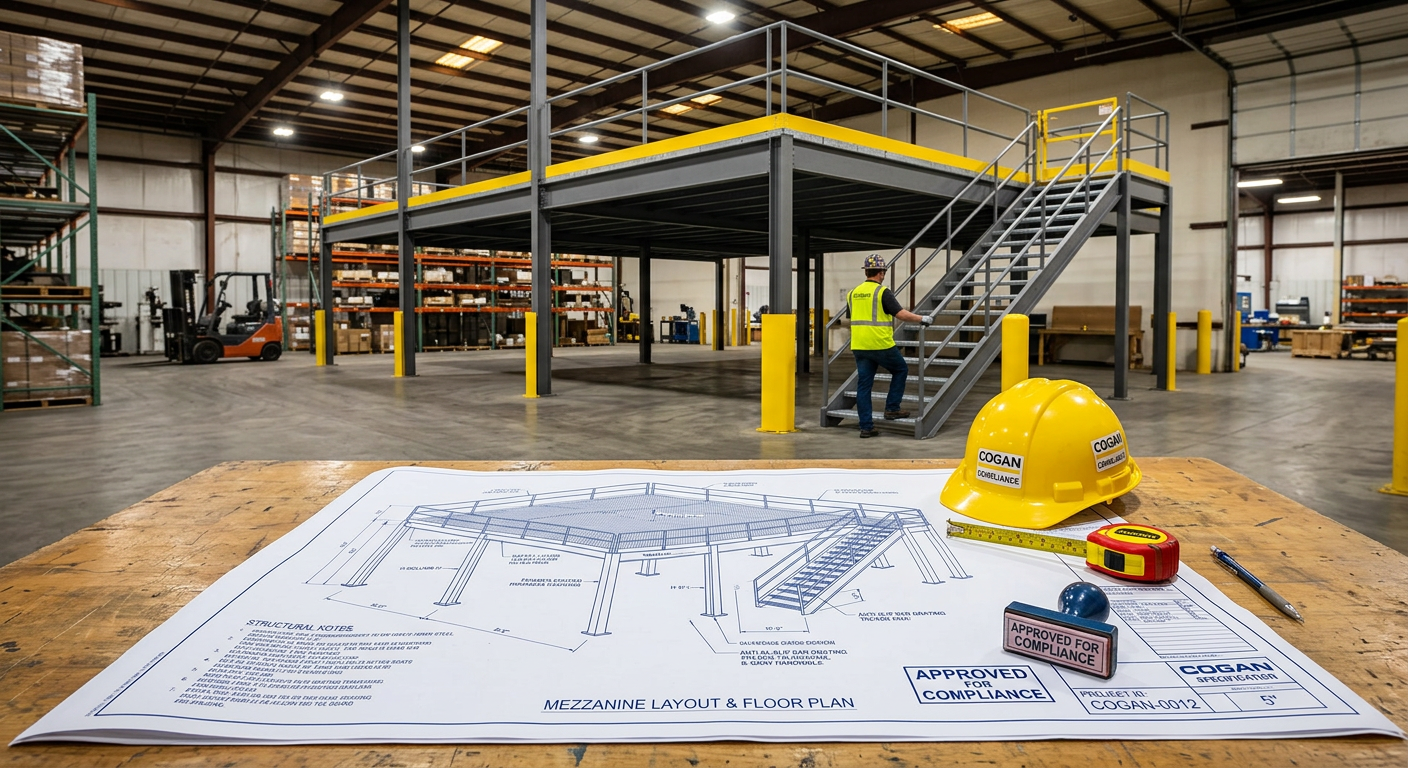
Every mezzanine in Canada requires structural drawings stamped by a licensed Professional Engineer (P.Eng.) in the province where the mezzanine will be installed. The PE stamp certifies that:
- The design meets all applicable building codes and standards
- Structural calculations have been performed and verified
- The design is suitable for the intended loads and conditions
- A qualified professional takes responsibility for the design
Do not accept a mezzanine design without a PE stamp. It is a legal requirement, it is essential for obtaining a building permit, and it protects you in the event of any structural issue.
How Cogan Handles Compliance
Cogan has been engineering and manufacturing mezzanines in Canada for decades. Our approach to code compliance includes:
- In-house engineering team with expertise in NBCC and all provincial codes
- PE-stamped drawings provided for every project, specific to the installation province
- Complete permit packages including structural calculations, connection details, and code compliance documentation
- Coordination with local authorities to address any jurisdiction-specific requirements
- Inspection support during and after installation
Our goal is to make the compliance process seamless for our clients. You should never have to worry about whether your mezzanine meets code, because we engineer it to meet code from the start.
Get a Code-Compliant Mezzanine Design
Every Cogan mezzanine comes with PE-stamped engineering drawings and a complete permit package.
Request Your Free QuoteFrequently Asked Questions
In virtually all cases, yes. A mezzanine adds floor area to a building, which triggers building permit requirements under every provincial building code. Some jurisdictions may have exemptions for very small platforms or equipment platforms that are not occupied, but any mezzanine intended for storage, work, or occupancy requires a permit. Always check with your local building department.
If the mezzanine area exceeds 40% of the room area, it is classified as a full storey rather than a mezzanine under the NBCC. This triggers additional code requirements including potentially different building classification, fire separation requirements, additional egress provisions, and structural considerations. It is still possible to build, but the engineering and permit requirements increase. Cogan can help you evaluate whether to stay within the 40% limit or design for full-storey classification.
No. The PE stamp must be from an engineer licensed in the province where the mezzanine will be installed. An Ontario P.Eng. stamp is not valid for a mezzanine in Quebec, and vice versa. Cogan has engineering relationships across Canada to provide appropriate PE stamps for every province.
Permit timelines vary by municipality. Simple mezzanine permits in smaller municipalities may be issued in 2 to 3 weeks. Larger cities like Toronto, Montreal, or Vancouver may take 4 to 8 weeks for plan review. Cogan's complete permit packages with PE-stamped drawings help minimize review time by providing all required documentation upfront.
Related Articles
Industrial Mezzanines: A Complete Guide
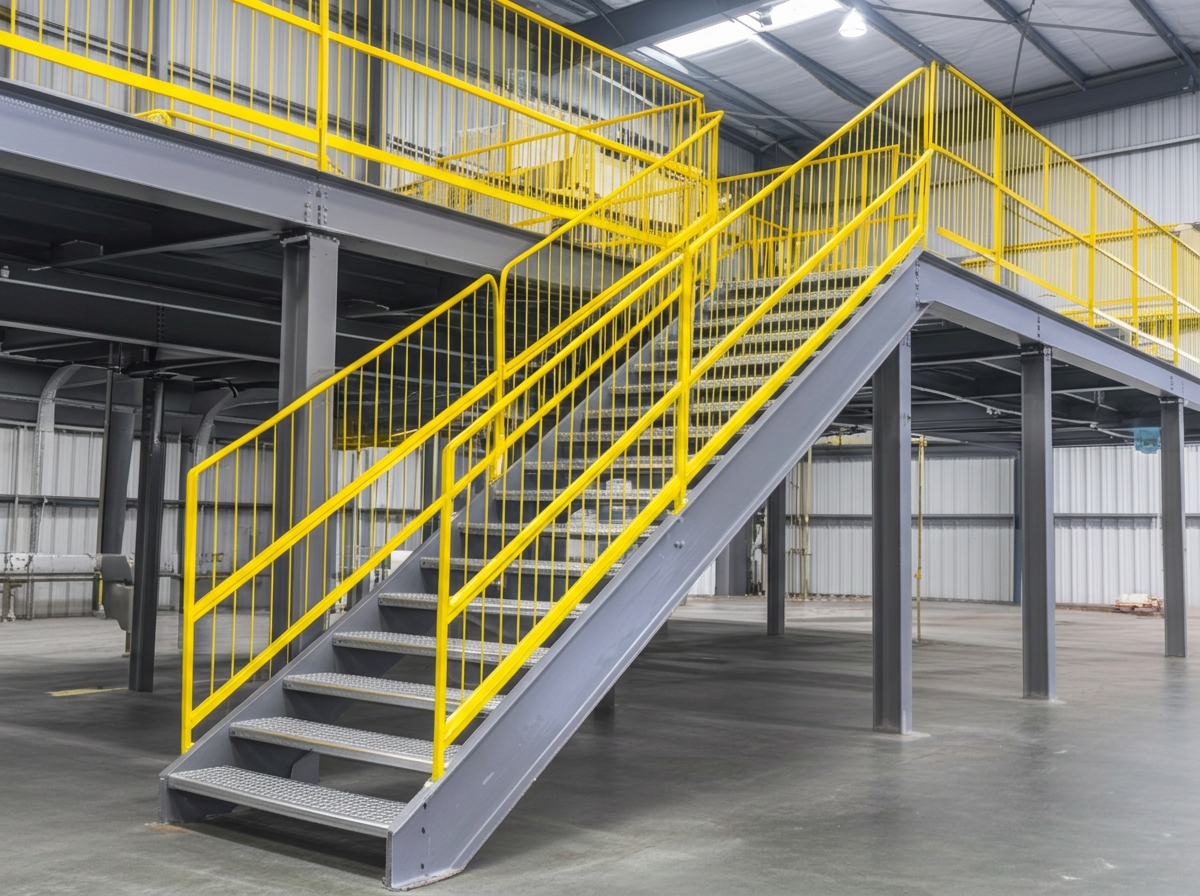
Industrial mezzanines are intermediate floor systems installed between a building's floor and ceiling to create additional usable space without expanding the building's footprint. Learn about types, benefits, applications, and engineering considerations.
Mezzanine vs Warehouse Expansion Guide
Should you build up with a mezzanine or build out with a warehouse expansion? This decision framework compares timelines, disruption, flexibility, and total value to help you choose.

10 Creative Mezzanine Applications
Mezzanines aren't just for warehouses. Discover 10 creative applications from breweries and climbing gyms to auto dealerships and micro-fulfillment centers.
© 2025 Cogan Wire and Metal Products Ltd., all rights reserved.