


Warehouse Safety Barriers & Guardrails Guide
Key Takeaways
- With over 11% of US forklifts involved in an accident each year, physical separation of traffic and people is the core of warehouse safety.
- Heavy-duty guardrails are the crash-rated layer — engineered to withstand a 10,000-lb impact at 4 mph.
- Pedestrian barriers (1.9" rails, 2-rail or 3-rail, meeting OSHA standards) guide foot traffic — they are not crash barriers.
- Lift-out rails open temporary access routes without removing protection; self-closing gates keep barrier lines continuous at openings.
- Match the barrier to the risk: crash protection, walkway guidance, or asset guarding — most facilities need a combination.
Warehouse safety barriers are fixed steel systems — guardrails, pedestrian railings, bollards and gates — installed to physically separate powered traffic from people, equipment and structures. Painted lines rely on attention; steel does not. With over 11% of forklifts in the United States involved in some kind of accident each year, a barrier plan is the most dependable safety investment a facility can make. This guide explains the barrier types and where each belongs.
Heavy-duty guardrails — the crash-rated layer
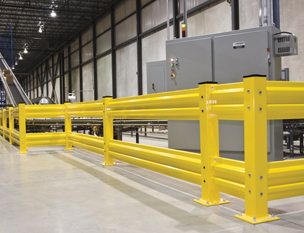
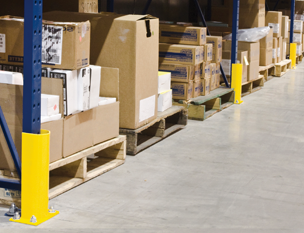
Cogan heavy-duty guardrails are engineered to withstand a 10,000-lb impact at 4 mph — genuine collision protection for the places a forklift can actually reach.
| Component | Specification |
|---|---|
| Rails | Roll-formed 13-gauge structural steel, meets ASTM A1011 Grade 45; standard sizes 2' to 10' (center-to-center 12" to 120") |
| Double-rail columns | Standard 44"H, 5" x 5" x 1/8" steel on a 10" x 10" x 1/2" base plate; 45 lbs |
| Single-rail columns | Standard 18"H; 27 lbs |
| Hardware | Rails bolt with Ø1/2" x 7" carriage bolts; columns anchor through (4) 3/4"ø base holes |
| Finish | Powder-coated safety yellow; limited lifetime warranty |
Choose single-rail (18") for low protection along walls and equipment bases, or double-rail (44") where pedestrians work beside traffic lanes. Lift-out brackets let rails slip in and out of saddles, so a protected line can open for a delivery and close again in seconds.
Pedestrian barriers — guide people, mark walkways
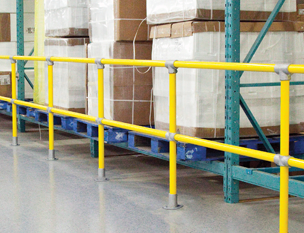
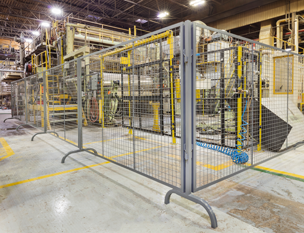
Pedestrian barriers are the lighter, modular layer: 1.9"-diameter steel rails in 2-rail and 3-rail configurations that meet OSHA safety standards, with rail lengths from 2' to 12'. Modular fittings — elbow sockets, T-sockets, side outlets and cut-to-size rails — let the railing follow any walkway layout. Two rules matter:
- They mark and guide foot traffic — routes to break rooms, offices and exits.
- They should never be used as fall protection or as a crash barrier — that's the job of heavy-duty guardrail (or mezzanine handrail at elevation).
Self-closing safety gates — keep the line continuous
Every opening in a barrier line is a gap in protection unless it closes itself. Cogan self-closing safety gates use spring-loaded hinges and adjust to opening widths of 24"–36" or 33"–48". The symmetrical design swings left or right, and the same gate mounts to guardrail, pedestrian railing or a mezzanine system.
Where to place barriers: a walkthrough
| Location | Risk | Right barrier |
|---|---|---|
| Walkways beside traffic lanes | Forklift strikes pedestrians | Double-rail heavy-duty guardrail (44") |
| Foot-traffic routes, queue lines | People wandering into work zones | Pedestrian barrier, 2- or 3-rail |
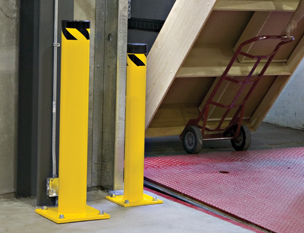
| Machinery, panels, building columns | Vehicle impact on assets | Single- or double-rail guardrail |
| Delivery and access routes | Protection vs. access conflict | Guardrail with lift-out rails |
| Openings in any barrier line | Gaps left open | Self-closing safety gate |
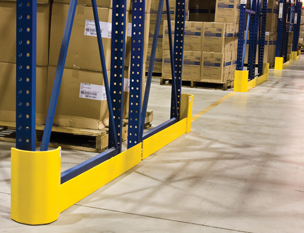
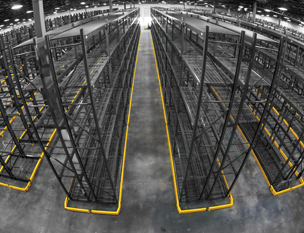
| Rack aisle ends and upright bases | Forklift turns hitting racking | Rack protection (wrap-around guards, post protectors) |
Planning tips
- Follow the forklift paths first. Every place a truck can physically reach a person or asset is a candidate for crash-rated rail; everywhere else, lighter pedestrian railing does the job at lower cost.
- Design access in, don't cut protection out. Lift-out rails and self-closing gates exist so that "we need to get through here" never becomes a permanent gap.
- Think visibility. All Cogan barriers ship powder-coated safety yellow — the barrier itself becomes the visual lane marking.
- Standard sizes are in stock. Guardrails and barriers are Ready Made and ship fast, so a safety upgrade doesn't wait on a fabrication cycle.
Frequently Asked Questions
What is the difference between a guardrail and a pedestrian barrier?
A heavy-duty guardrail is crash-rated — engineered to withstand a 10,000-lb impact at 4 mph. A pedestrian barrier is a lighter modular railing that guides foot traffic to OSHA standards and should never be used as fall protection or a crash barrier.
How strong is an industrial guardrail?
Cogan heavy-duty guardrails withstand a 10,000-lb impact at 4 mph, using roll-formed 13-gauge rails meeting ASTM A1011 Grade 45 on bolted steel columns.
What height should warehouse guardrails be?
Double-rail columns stand 44" high; single-rail columns are 18" for low-level protection. Pedestrian barriers use 1.9" rails in 2-rail or 3-rail configurations.
What are lift-out guardrails?
Rails that slip into saddle brackets instead of bolting permanently — lift them out to open an access route, drop them back to restore protection.
Where should safety barriers be installed in a warehouse?
Wherever powered traffic and people or assets share space: walkways, work cells, machinery, dock areas, electrical panels, rack ends and platform openings.
Map your barrier plan with an expert
Send us your floor plan — Cogan will spec the right mix of guardrails, pedestrian barriers and gates, in stock and ready to ship.
© 2025 Cogan Wire and Metal Products Ltd., all rights reserved.