


What Is Cantilever Racking? Arms, Columns & Load Guide
Key Takeaways
- Cantilever racking stores long, bulky or awkward loads — lumber, pipe, bar stock, extrusions — on arms extending from steel columns, with no front upright to obstruct loading.
- Cogan builds two structural column designs: LD (4" I-beam, 3" arm adjustment) and HD (5" I-beam, 4" arm adjustment).
- Arms come in 14 standard lengths from 12" to 96", straight or inclined (1.5° or 3°), single- or double-sided.
- All connections use high-strength structural-grade bolts (ASTM A325 at arm plates).
- Column and arm capacity are engineered per project — always confirm capacities on your approval drawings.
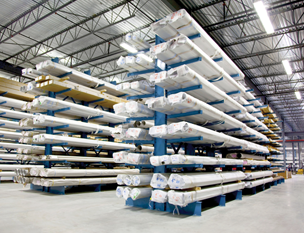
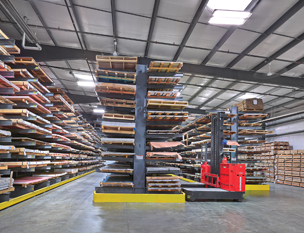
Cantilever racking is a storage system in which horizontal arms extend outward from vertical steel columns, leaving the front of the rack completely open. With no front upright in the way, long and awkwardly-shaped materials — lumber, pipe, tubing, steel bars, extrusions — can be loaded from the front at any point along the row. It is the standard solution for products that simply don't fit on pallet racking.
How does cantilever racking work?
Each bay is built from four elements:
- Columns — vertical structural steel I-beam uprights with punched holes running their full height, so arms can be repositioned as products change.
- Bases — shop-welded base plates anchoring the columns and counterbalancing the load.
- Arms — the load-bearing members, bolted to the column at the height you need.
- Bracing — cross and horizontal braces connecting columns into rigid rows, bolted with ASTM A325 structural bolts.
Racks are single-sided (arms on one face, typically against a wall) or double-sided (arms on both faces of a shared column line, doubling capacity per footprint).
LD vs HD columns — which do you need?
| Column design | Upright | Vertical arm adjustment | Suited for |
|---|---|---|---|
| LD | 4" structural I-beam | 3" increments | Medium- to heavy-duty loads |
| HD | 5" structural I-beam | 4" increments | Medium, heavy- and extra heavy-duty loads |
The column type is determined by a Cogan engineer based on the quantity of arms and the maximum load capacity per arm — always refer to your quote or approval drawings for exact column and arm capacities.
Cantilever arms: lengths, connections and incline
Structural arms are manufactured from structural S-sections, W-sections or equivalent, in 14 standard lengths: 12", 18", 24", 30", 36", 42", 48", 54", 60", 72", 78", 84", 90" and 96".
- Connection plates — six bolt-hole spacings (3"MD, 4"MD, 4"HD, 5"HD, 5.5"HD, 6"XHD) in 1/2" or 5/8" plate, each secured with 4 ASTM A325 structural bolts.
- Straight or inclined — arms can be inclined 1.5° or 3° from horizontal so cylindrical loads rest against the column.
- Stopper options — removable and fixed stopper pins slot into a 1 1/2" square sleeve and extend 6" or 12" above the arm; welded stopper lips and welded angle stoppers give a permanent stop.
- Accessories — "V" brackets cradle coils; "U" brackets support rods; wire mesh shelf overlays on beam supports convert bays into shelving.
How are cantilever rows braced?
Bracing keeps the row rigid and is laid out by height: on 12'-high runs, the first and last bays take a cross brace plus a horizontal brace; on 16'-high runs, the first and last bays take a double cross brace, with inside bays alternating quadruple horizontal braces and double cross braces. Like the arm connections, braces bolt with ASTM A325 structural bolts.
Indoor and outdoor finishes
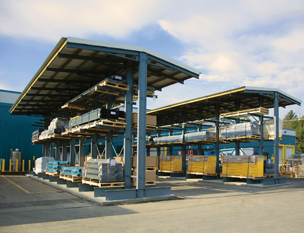
The Cogan standard finish is a durable powder coat for all indoor applications. For outdoor storage yards, columns and bases are coated in polyurethane liquid paint for enhanced durability — the racking keeps its finish even after years of exposure to the elements.
Frequently Asked Questions
What is cantilever racking used for?
Storing what doesn't fit on pallet racking: lumber, pipe, tubing, steel bars, extrusions, sheet goods and other long or awkwardly-shaped materials, loaded from the front without obstruction.
What is the difference between single-sided and double-sided cantilever racking?
Single-sided racks carry arms on one face (typically against a wall); double-sided racks carry arms on both faces of one column line, doubling storage per footprint.
Can cantilever racking be used outdoors?
Yes — for outdoor use, columns and bases are coated in polyurethane liquid paint for enhanced durability; the standard indoor finish is powder coat.
How much weight can a cantilever rack arm hold?
Arm capacity depends on connection type, arm length and column design — capacities are engineered per project and confirmed on your approval drawings.
How do you keep loads from rolling off cantilever arms?
Order arms inclined at 1.5° or 3°, or fit stopper pins (removable or fixed, extending 6"–12" above the arm) or welded stopper lips and angle stoppers.
Storing long or awkward materials?
Cogan structural cantilever racking is custom made — a perfect fit, every time. Tell us your loads and we'll engineer the rest.
© 2025 Cogan Wire and Metal Products Ltd., all rights reserved.