



Wire Mesh Partitions: Cages, Enclosures & Gates Guide
Key Takeaways
- Wire mesh partitions are modular steel walls — panels, posts and gates that bolt together into cages, enclosures and secure rooms inside a building.
- The standard panel is 2" x 2" x 10-gauge welded wire mesh in a 1 1/4" x 1 1/4" structural angle frame — wear-resistant, see-through and ventilated.
- Posts reach 24' freestanding, 42' with roof, 48' floor-to-ceiling, spaced 2' to 10' center-to-center.
- Eight families cover different jobs: wire mesh, sheet metal, sheet metal/Lexan, DEA cages, machine guarding, rack guards, rack gates and mobile partitions.
- Eight gate types — swing, sliding, bi-parting, tunnel, Dutch and service wicket — match every traffic pattern from a walk-through door to full-height forklift access.
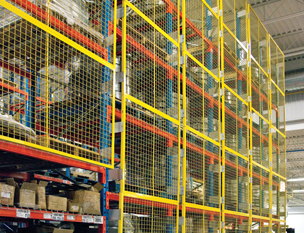
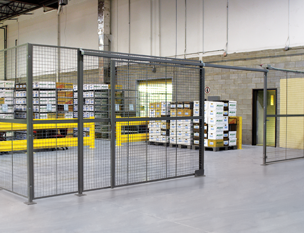
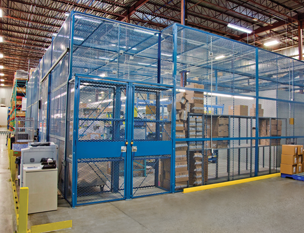
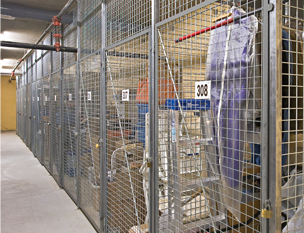
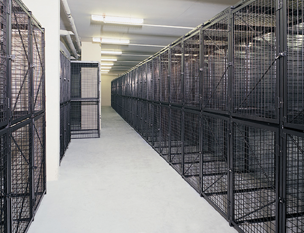
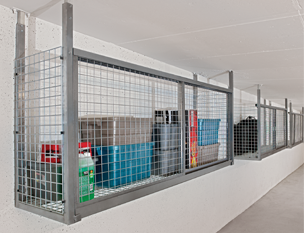
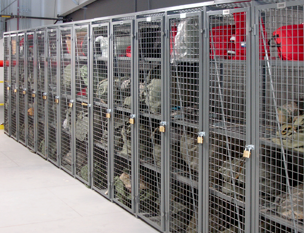
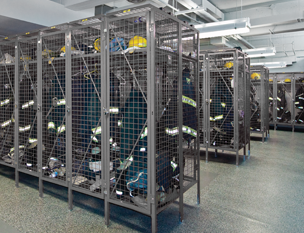
A wire mesh partition is a modular steel wall system — welded wire mesh panels framed in structural angle, bolted between steel posts — used to build secure cages, enclosures and rooms inside an existing building. Developed by Cogan over 50 years ago, the all-steel construction resists wear and requires no maintenance, while the open mesh keeps stored items visible, lets air circulate and light penetrate. Corner, three-sided or fully-enclosed layouts assemble from the same standard components.
How is a wire mesh partition built?
Three components make up every enclosure:
- Panels — 2" x 2" x 10-gauge welded wire mesh framed in 1 1/4" x 1 1/4" x 12-gauge structural angle. Standard heights 1' to 5', widths 2' to 10'.
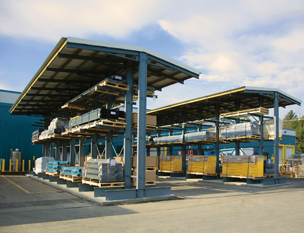
- Posts — the vertical structure, in three designs: freestanding (up to 24'), freestanding with framed roof panels (up to 42'), and floor-to-ceiling top-fix (up to 48'). Standard spacing 2' to 10' center-to-center.
- Gates — framed mesh doors with two welded 1/2"ø reinforcement rods, padlock hasps, hinges and door stoppers standard.
Everything assembles with nuts and bolts, so an enclosure can grow or move as the operation changes. Standard components are covered by a limited lifetime warranty, and accelerated production is available on core components.
Which gate fits your traffic?
| Gate type | Standard heights | Standard widths | Best for |
|---|---|---|---|
| Single swing | 6' – 15' | 3' – 10' | Walk-through and general access |
| Double swing | 6' – 15' | 6'-3" – 16'-3" | Wide openings, equipment passage |
| Single sliding | 7' – 20' | 3' – 20' | Constricted areas — no swing clearance needed |
| Bi-parting sliding | 7' – 20' | 6' – 24' | Very wide openings in tight spaces |
| Tunnel | 8' – 12' | 4' – 9' | Full-height forklift clearance, on 5" rolling casters |
| Bi-parting tunnel | 8' – 12' | 8' – 16' | Forklift access on wide bays |
| Service wicket | 7' + 1' transom | 3' – 5' | Service counter — top opens, bottom fixed |
| Dutch | 7' + 1' transom | 3' – 4' | Walk-through plus service counter in one |
The eight partition families
| Family | What's different | Typical use |
|---|---|---|
| Original wire mesh | 2"x2"x10GA mesh, see-through and ventilated | Tool cribs, secure storage, stockrooms |
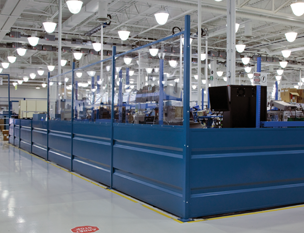
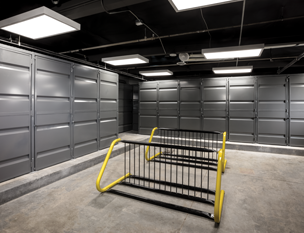
| Sheet metal | Corrugated steel panels — opaque for privacy | Welding screens, confidential storage, changing rooms |
| Sheet metal / Lexan | 3/16" transparent polycarbonate panels, mix-and-match with steel | Noise reduction with visibility |
| DEA drug storage cages | Tighter 2"x1", 1"x1" or expanded-metal mesh; self-closing standard gates | Controlled-substance storage (Title 21 CFR 1301.72–76, Health Canada) |
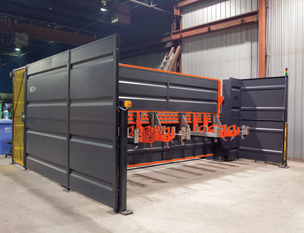
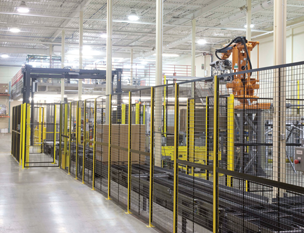
| Robotic machine guarding | Safety yellow and midnight black finish; 7'–8' posts | Guarding robots, conveyors, automated equipment |
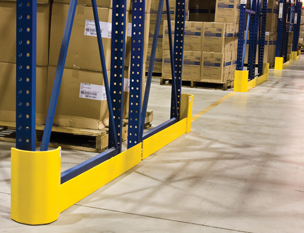
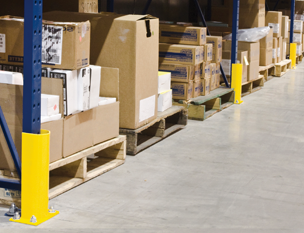
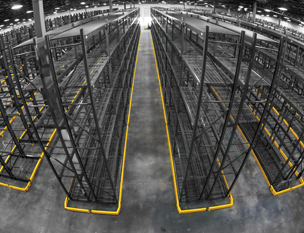
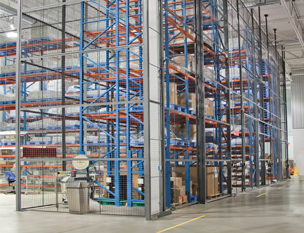
| Wire mesh rack guards | Panels that bolt to pallet rack uprights | Stopping product falling behind racking |
| Rack gates | Fully-suspended sliding gates on galvanized top track — no bottom track | Closing rack aisles, 3'W x 8'H up to 12'W x 30'H |
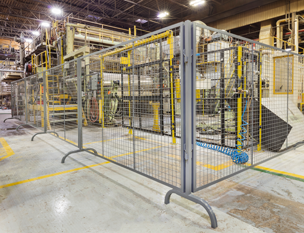
| Mobile partitions | Freestanding panels with hook-in posts, 7" floor sweep, no special tools | Temporary zones that move with the work |
What makes a DEA cage different?
A standard partition secures property; a DEA cage must satisfy regulators. Cogan DEA cages are built to meet the US Drug Enforcement Administration's physical-security requirements for Schedule III through IV controlled substances, as stipulated in Title 21 CFR Sections 1301.72–1301.76, and the Health Canada Directive on Physical Security Requirements for Controlled Substances. The practical differences: tighter mesh options (2"x1", 1"x1" or 10-gauge expanded metal), self-closing standard gates, and post options up to 48' floor-to-ceiling — so the cage closes the room from slab to deck.
When to choose sheet metal or Lexan instead of mesh
- Privacy or containment — corrugated sheet metal panels block sight lines and weld flash: changing rooms, confidential storage, welding areas.
- Visibility with separation — 3/16" Lexan polycarbonate panels keep supervisors' sight lines open while containing noise; panels mix and match, e.g. steel below, Lexan above.
- Machine guarding — robotic machine guards address one of OSHA's top-ten violation categories each year: unguarded machinery. Safety yellow and black finish comes standard.
Frequently Asked Questions
What are wire mesh partitions made of?
Panels of 2" x 2" x 10-gauge welded wire mesh framed in 1 1/4" x 1 1/4" x 12-gauge structural angle, with welded 1/2"ø reinforcement rods in gate doors — wear-resistant, ventilated and see-through.
How tall can a wire mesh partition be?
Up to 24' freestanding, 42' freestanding with roof, and 48' floor-to-ceiling, with posts spaced 2' to 10' center-to-center.
What is a DEA drug storage cage?
A wire mesh enclosure meeting DEA physical-security requirements for Schedule III–IV controlled substances (Title 21 CFR 1301.72–76) and the Health Canada Directive, with tighter mesh and self-closing standard gates.
Which partition gate should I choose?
Swing gates for standard access, sliding/bi-parting for constricted areas, tunnel gates on casters for full-height forklift clearance, Dutch and service wicket gates where you need a service counter.
Can wire mesh partitions be moved or reconfigured?
Yes — nut-and-bolt assembly makes reconfiguration straightforward, and mobile partitions with hook-in panels move without specialized tools.
Enclosing an area?
Send us the footprint and height — Cogan will configure posts, panels and the right gate, backed by a limited lifetime warranty.
© 2025 Cogan Wire and Metal Products Ltd., all rights reserved.